Understanding the Apple M5 Chip
1. Introduction: What is the Apple M5 Chip?
Apple M5 Chip is Apple’s latest powerhouse SoC, designed to deliver faster CPU, GPU, and AI performance in iPads, MacBooks, and more.The Apple M5 is an advanced System on a Chip (SoC), which means it combines all the essential processing components of a computer onto a single, powerful piece of silicon.
Think of an SoC as the “brain and nervous system” of a device. Instead of having separate parts for thinking (CPU), creating visuals (GPU), and specialized learning (Neural Engine), they are all integrated onto one chip. This design allows them to communicate with each other at incredible speeds, making devices faster and more power-efficient.
This guide will break down the most important parts of the M5 chip to help you understand how they work together to power Apple’s latest devices. Now that we know the M5 is a complete system on a single chip, let’s explore its core components and what each one does.
2. The Core Architectural Components
The M5 chip is like a high-performance team, with specialized players that are experts at handling different kinds of tasks. By working together, they deliver a huge boost in overall speed and intelligence.
2.1. Apple M5 Chip CPU: The ‘Thinker’ Behind Incredible Speed
The CPU is the main processor that handles most of a computer’s general tasks, from opening apps to browsing the web. The M5’s CPU is designed for both power and efficiency.
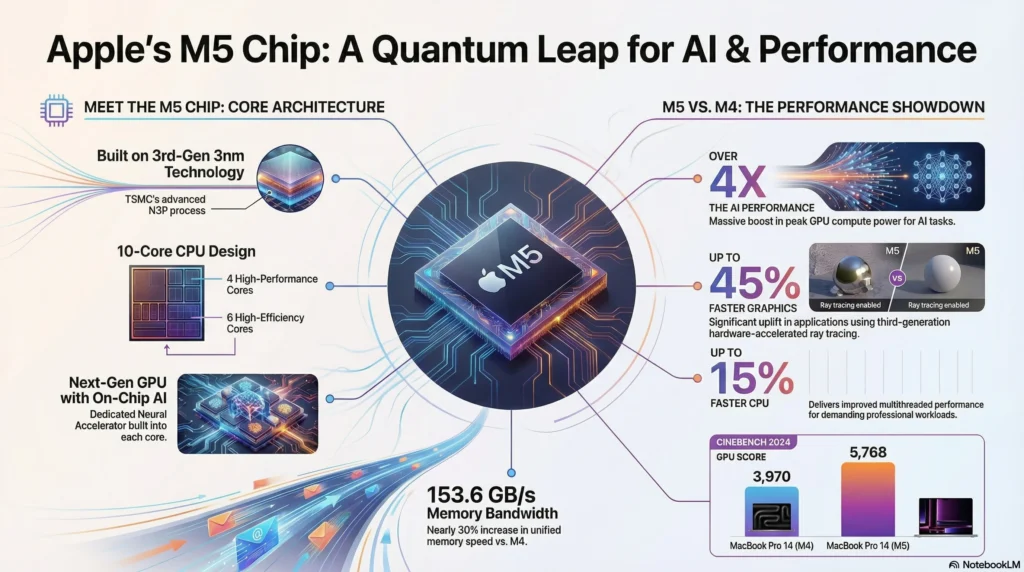
- 10-Core Design: The CPU is split into two types of cores that work together.
- 4 Performance Cores: These are for heavy-duty tasks that require maximum speed. Apple describes these as the “world’s fastest performance core.”
- 6 Efficiency Cores: These handle lighter, background tasks, which helps save a tremendous amount of battery life.
This intelligent split allows the M5’s CPU to deliver up to 15% faster multithreaded performance compared to the M4 chip. This means your computer is quicker at juggling multiple tasks at once, like exporting a video project for class while simultaneously researching your next assignment with dozens of browser tabs open.
2.2. The Graphics Processing Unit (GPU): The “Artist” & “AI Powerhouse”
The GPU traditionally handles everything you see on the screen-from smooth animations and high-resolution video to realistic graphics in video games. However, in the M5, the GPU takes on a massive new role: accelerating Artificial Intelligence (AI).
- Next-Generation Architecture: The 10-core GPU has a completely new design that integrates a dedicated Neural Accelerator into each core. This is the key to its enormous AI performance boost.
- AI Performance Leap: This new architecture delivers over 4x the peak GPU compute performance for AI compared to the M4 chip.
- Enhanced Graphics: Overall graphics performance is up to 30% faster than the M4. For visually demanding applications like gaming with advanced lighting effects, the M5 is up to 45% faster in applications using ray tracing.
- Dynamic Caching: It includes a rearchitected second-generation dynamic caching system. This system intelligently allocates memory for graphics tasks in real-time, ensuring the GPU gets exactly what it needs, which prevents waste and boosts performance in games and creative apps.
2.3. The Neural Engine: The “Dedicated Genius”
The Neural Engine is a specialized processor designed exclusively to accelerate machine learning (ML) and AI tasks. It’s the part of the chip dedicated to making “smart” features feel instant.
The Neural Engine helps with tasks like:
- Real-time video analysis
- Voice recognition and transcription
- Advanced image processing
- Powering Apple Intelligence features on devices
The improved 16-core Neural Engine works alongside the new Neural Accelerators in the GPU, making the entire M5 chip a powerhouse fully optimized for modern AI workloads.
2.4. Unified Memory: The “Super-Fast Workspace”
Unified Memory is one of Apple silicon’s signature features. Instead of having separate pools of memory for the CPU and GPU, all components share a single, high-speed pool.
Imagine a shared workbench where the “Thinker” (CPU), “Artist” (GPU), and “Genius” (Neural Engine) can all access their tools (data) from the same place instantly. They don’t have to waste time and energy passing data back and forth, which makes the entire system faster and more efficient.
| Feature | What It Means for You |
| 153.6 GB/s Bandwidth | Nearly 30% faster than the M4, this means data moves around the chip much more quickly. Multitasking feels smoother and apps are more responsive. |
| Up to 32 GB Capacity | This large capacity allows you to run many demanding applications-like professional photo or video editors-at the same time without slowdowns. |
| Unified Architecture | This massive memory bandwidth is precisely what allows the GPU’s Neural Accelerators and the Neural Engine to run larger AI models completely on-device without bottlenecks. |
While understanding these individual parts is crucial, the real magic happens when we see how these architectural improvements translate into tangible, real-world speed.
3. M5 in Action: Performance and Products
These architectural upgrades result in significant real-world speed improvements, making M5-powered devices noticeably faster and more capable than those with the M4 chip.
3.1. Current M5 Devices in Pakistan
As of December 2025, the following Apple M5 laptops are available in Pakistan:
These devices deliver excellent performance for creative professionals, students, and AI workloads. Available at local sellers like Mega.pk
Other M5 devices include:
- iPad Pro (M5 Chip) – pre-booking available in Pakistan
- Apple Vision Pro (M5 Chip) – announced 2025
3.2. Upcoming M5 Series (2026)
Apple is expected to expand its M5 lineup:
- MacBook Pro 16″ (M5 Pro / M5 Max) – expected Q1 2026
- MacBook Air (M5) – early/mid‑2026
- Mac mini & iMac (M5 variants) -expected later in 2026
3.3. Performance at a Glance: M5 vs. M4
Here is a summary of the most significant performance gains offered by the M5 chip over its predecessor, the M4.
- CPU Performance: Up to 15% faster multithreaded performance.
- AI Performance: Over 4x the peak GPU compute for AI.
- Graphics Performance: Up to 30% faster overall, and up to 45% faster in ray-traced applications.
- Memory Bandwidth: Nearly 30% faster, with 153.6 GB/s compared to the M4’s 120 GB/s.
3.5. Where Can You Find the M5 Chip?
The Apple M5 chip was announced on October 15, 2025, and powers the following new devices:
- iPad Pro (2025)
- 14-inch MacBook Pro (2025)
- Apple Vision Pro (2025)
With this tour of its capabilities, we can see that the M5 chip is a powerful and intelligent engine that brings major speed boosts to Apple’s latest devices.
4. Conclusion: A Leap Forward in AI and Efficiency
The Apple M5 is more than just a simple speed bump over the previous generation; it represents a holistic shift in architecture, strategically designed to power the next wave of Artificial Intelligence. It’s a story of purposeful integration, where every component’s improvement serves a single, clear goal: creating a remarkably capable and efficient engine for on-device AI. The faster CPU, the GPU’s new Neural Accelerators, the dedicated Neural Engine, and the massive memory bandwidth all work in concert to unlock the next generation of creative, productive, and intelligent applications on Apple devices.